

The book you’ve all been whaling for - Whalefall By Daniel Kraus
So, my little horror gremlins, I’ll deep-diving into all this book has to offer in the following order:
Themes
Style/pacing/structure
Gore Factor (Did it give me the heebie jeebies? Did if gross me out enough? Did it make me feel tight and uncomfortable?)
Moving Quotations.
Gory Quotations.
Personal Thoughts and Rating (Would I recommend the book to you as a gore horror or a liminal space horror).
Hopes for the film - COMING OUT ON OCTOBER 16TH 2026.
This book discussed a plethora of interesting themes that captivated me the whole way through: SPOILER WARNING
The familial conflict between Jay Gardiner (Our main protagonist that we follow through the story) and Mitt Gardiner (Jay’s father - Initially depicted as the crux of his suffering. But, as the story progresses, Jay comes full circle with his harsh upbringing and utilises his father as a means of being reborn. He does this by appreciating his Dad’s harshness, his seemingly pointless ocean trivia’s and his hard grafting to catalyse his own escape from the whale’s stomach (An escape which, of course, possesses a literal and metaphorical meaning, both of which are intricately woven in Kraus’s poetic prose that flows through the novel).
Nature and Transcendence - Mental Rebirth (The inconsequential position of terrestrial organisms compared to the grandness of the ocean that humans spoil, pollute and disrespect constantly. Jay, through his madness and philosophical contemplations inside the whale, comes to greatly respect the life of the ocean for rebirthing itself constantly to maintain the wonderous cycle of life. A cycle that humanity is evidently hell bent on destroying for the purposes of fuelling their insatiable greed. Jay realises this. He realises that it didn’t matter that his father was harsh on him. He didn’t hold his part of the natural cycle by tending to his father who was dying of cancer. So, in a way, the way that Jay rectifies his mistake in the natural cycle is by mentally adapting to the flows of this natural cycle in the ocean, and through it, he is reborn by escaping the whale as a whole new person).
THEME 1 - THE FAMILIAL CONFLICT BETWEEN JAY AND MITT GARDINER:
Jay Gardiner (The son) and Mitt Gardiner (The Father) have quite a dicey relationship with one another. Jay is portrayed as a sensitive young man who resonates more with the women in his life than he does with his father who is a lot harsher and blunt towards him than his sisters. Jay takes this to heart and it builds up into a hateful grudge that reaches its climax on a boat ride: His father is drunk, talks about the squalor that the ocean is in because of humans and he cuts himself with a beer can as a sign of respect for the ocean. He encourages Jay to do the same and tries to cut him. Jay flips out, jumps into the ocean and swims back to shore and doesn’t speak to his father again. Even when his father is dying of lung cancer, he still doesn’t come to visit him when he’s dying because Jay’s grudge against his father was just too big.
So, the story threads the idea that Jay thinks it’s all his father’s fault for making him the way he is. A sensitive, closed-off young man. But, as the story progresses, Jay starts seeing the sperm whale he’s inside of as his father…DAMN…THAT’S SOME NITROGEN NARCOSIS RIGHT THERE!
So yes. He speaks to the whale who speaks to him in his head in the voice of his father. Through these inner conversations, Jay realises that in the cycle of life (like we see in the ocean and how the sperm whales look after one another) you cannot afford to be selfish and hold grudges that isolate you from the world. This is because, in the end, we’re all responsible for each other and have to look out for one another, unless, you want to dig a deeper hole (or get eaten by a whale) and go through hell trying to fix your big mistake. Jay didn’t realise this when his dad last spoke to him and said: “Don’t son’s have responsibilities too?”. Now he has to bleed, break his body, defy the odds and go against a giant squid just to get out of the hole that he’s been digging from the moment he let the grudge grow.
Of course he escapes, but not without getting the scars that Mitt said he would get from living. He manages to utilise the methane inside of the whale to blow it up. KAPOW. HE’S OUT! But now he’s got to wade through chunks of whale blubber, blood and it’s massive heart if he wants to be found by the tourist ship nearby. So he gnaws his way through the heart. Based on my interpretation, I see this as a metaphor for eating his father’s lessons, taking it all in and letting go of the grudge by mashing his way through the whale’s/his father’s heart.
Summary - Don’t hold grudges if you want to grow into a new person. Let the bad times come, learn from them and keep moving forward until it’s time to fill in your part in the cycle of life through your death.
THEME 2 - NATURE AND TRANSCENDENCE:
So, we got the humans who think that we’re the dominant ones who are free from the cycle of rebirth we see in the ocean. But, even us terrestrial creatures, have a cycle that we must adhere to so that the balance can be maintained. The balance in the family dynamic. The balance with have in our own strengths and weaknesses in all walks of life. It all circles back to keeping the balance. Something that Jay Gardiner has not been doing for a long time, and now it’s come to strike the balance in the stomach of a sperm whale.
Through this horrifying experience, Jay learns the meaning of rebirth, the importance of looking out for others and letting go of grudges that weigh more heavily than the dwindling tank of oxygen strapped to Jay’s back. Transcendence is not necessarily being divine in the physical but radically changing your perception of the world to fit in with the flows of the nature and the grandness of the ocean. That’s quite a major feat in a world where everything is so finite and fruitless. Albeit, he almost dies from trying to rectify the balance by letting go of the grudge against his dad, but the more one goes against striking the balance, the harder it hits you in the long run.
STYLE/PACING/STRUCTURE:
This is one of the problems that I had with this book. The style is predominantly poetic prose with sprinkles of the deep voice and splash of the straight talk voice to keep the book grounded. But I think this book uses too much of the poetic prose for such a horrifying event, especially towards the end where he’s surrounded by whale blubber and is thinking about the lessons of his father.
Another thing was that the book felt a little slow at times as it shifts between the past (The source of his grudge against his father, his experiences and the reasons he acts the way he does) and the present (In the stomach of an old sperm whale). But when the man’s about to get swallowed by a sperm whale, I think there should have been a little more focus on that, rather than having a flashback to his father calling the sperm whale - “the old father of the sea”. It works for weaving the syntax and metaphors, not so good for keeping the tension in a high intensity situation.
These are just things that caught my eye and made the book feel like it lost its rhythm in places. But, to finish on a high, Kraus utilised some of the most effective poetic prose and liminal space imagery I have come across. So, if you like all the gory details with a side of gore, then this book would be a great read for you.
GORE FACTOR - DID IT GIVE ME THE HEEBIE JEEBIES?
YES IT CERTAINLY DID! WHOOP!
Great Gore | Uncomfortable liminal space imagery | Unexpected Avenues of escape - all of them possessing gruelling details of blood, stomach fluids, sludge, brine, flesh and bones - Seems to be hitting all the boxes.
GORE FACTOR RATING - 8.5/10
MOVING QUOTATIONS:
People aren’t doors. They’re whole floor plans, entire labyrinths, and the harder you try to escape, the more lost in them you become.
“The refrain is but two words: and the world is the comma between them. Sleeper, arise!”
“No one carries the best parts of themselves. The best parts are those held inside others”
“If you can’t know what’s right in front of you, you can’t know what’s beyond you”
GORY QUOTATIONS and LIMINAL SPACE IMAGERY:
“His tank makes it difficult. So does the warm, rubbery stomach which grips like a wet athletic sock”
“Jay survived ingestion. So did Architeuthis. Twenty suckers ringed in sawblade teeth screw into Jay’s neck. He feels his wetsuit tighten, then a liquid gush. It’s his throat slit, lifeblood slurping out”
“He tips open the bottom of his mask, exposing his nostrils. The unholy stench. Fish market gone bad, brine and blood. The melon sweetness of curdling bacteria”
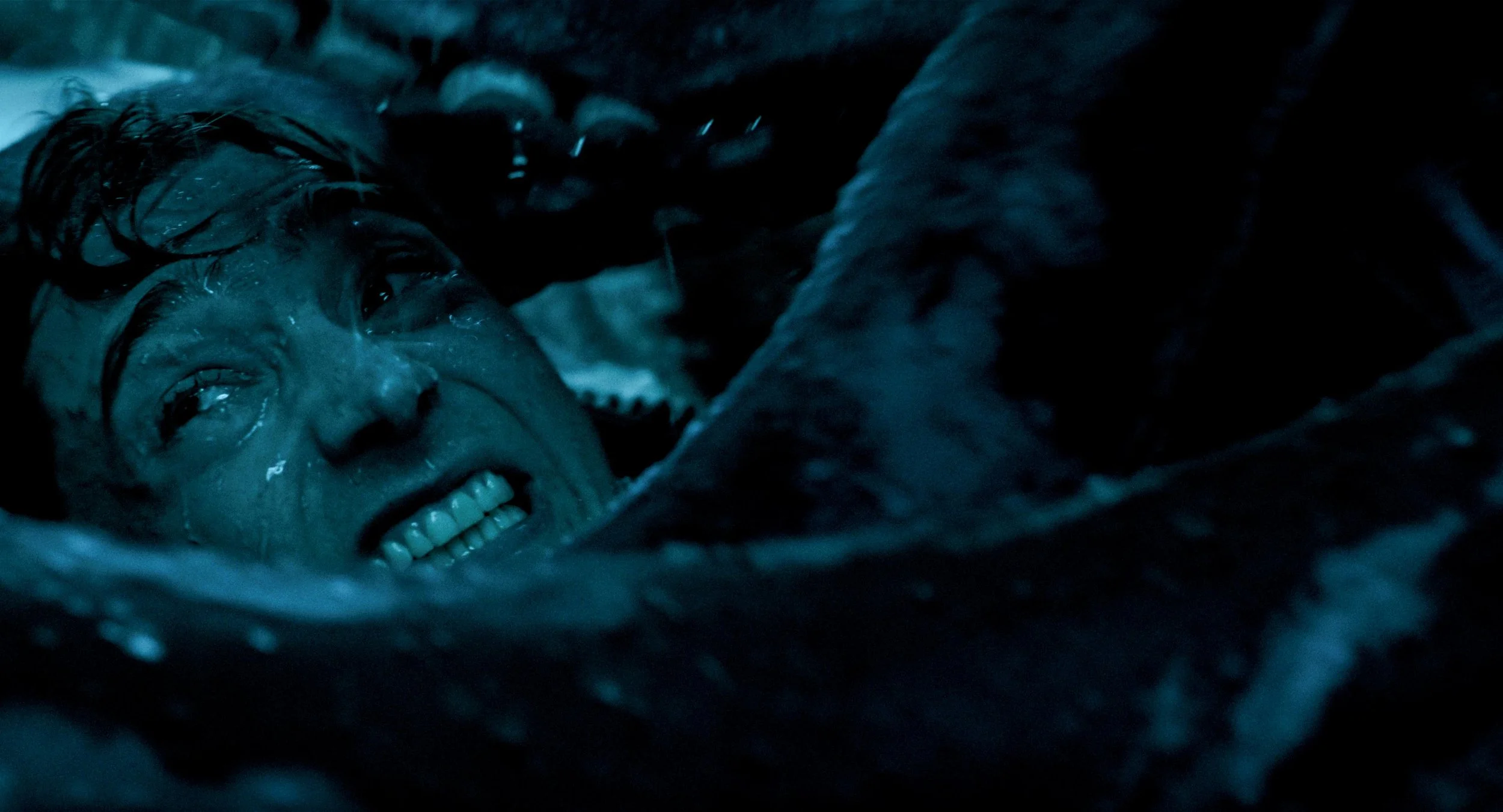
Jay Gardiner having a rough and tumble with a giant squid in the belly of a sperm whale. If that’s not original, I don’t know what is.
CLICK TO WATCH THE TRAILER!
MY PERSONAL THOUGHTS ON THE BOOK + RATING:
To put it short: Loved the gory descriptions and liminal space imagery + liked the syntax and extended metaphor weaved throughout the book. But I didn’t like how the book’s structure and poetic prose took me away from the tension of some of the events described. All in all I would give the book:
3 and a half stars - DECENT READ
HOPES FOR THE FILM COMING OUT ON OCTOBER 16TH 2026:
After reading the book, I’ve got some high hopes for the film. Based on the trailer and the book, it looks like it’s going to be quite gory (Packed to the brim with blood, gruesome body horror scenes from where jay sustains fatal injuries all over his body (Ribs protruding out of his wetsuit, eyes bulging out of their sockets (Fans of ‘Talk to Me’ will know what I’m talking about), mangled limbs (Gored right palm, broken legs, burn marks from the explosion inside of the whale) and possibly attempted suicide.
Given the sensitivity of suicide in film media, I am uncertain on how the film will approach this subject. Given that Mitt Gardiner kills himself by jumping off Hewey’s boat, the structure of the story has to envelop this theme into the context of the story for it to do justice to the book. Kraus even provides suicide helpline resources at the end of his novel which is a wonderful addition from the author. However, I’ve got a good feeling that the film will deliver on the gore, the gross liminal space of the whale’s stomach, tension build-up for Jay’s depletion of oxygen and the deep extended metaphor of rebirth that is spun throughout the book. But given the sensitivity of talking about the subject, let alone in the gory, frightening setting of the whale’s stomach, I am not sure if the film will weave through the theme of suicide as well as Kraus did in his book.
BUT…WE’LL HAVE TO WAIT AND SEE :)